Sacred Scrolls · Feature
The Voynich Manuscript: The Book That Will Not Be Read
By Veronica Bey · 11 min
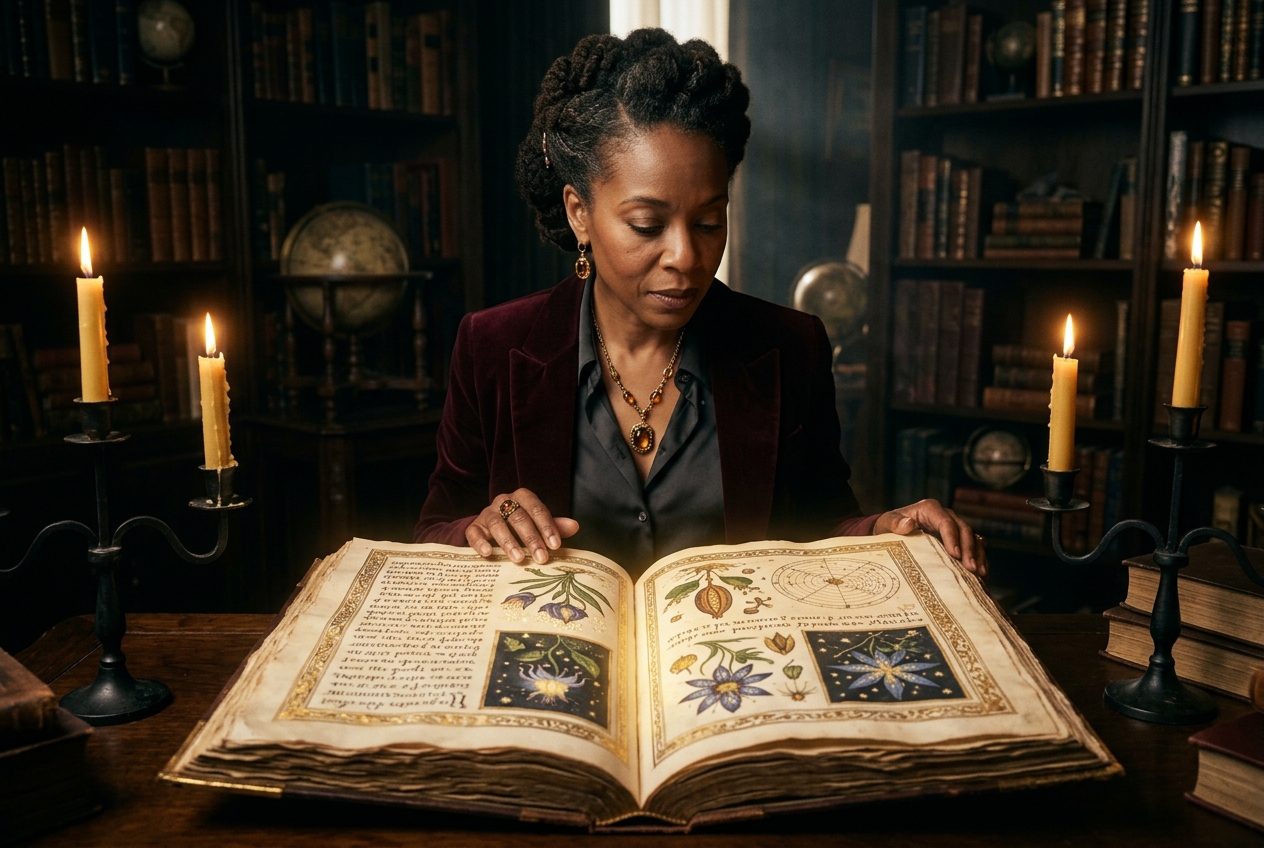
There is a book at Yale that no living person can read. Catalogued as Beinecke MS 408 and known to the world as the Voynich Manuscript, it is roughly 240 pages of looping, confident, utterly undeciphered script, surrounded by drawings of botanical specimens that match no plant on Earth, star charts, and pools of green water in which small nude figures bathe. It has defeated medieval scholars, wartime codebreakers, and now artificial intelligence. To hold its image is to feel the particular vertigo of a text that clearly means something and refuses, absolutely, to say what.
Begin with the science, because the science is settled where almost nothing else is. Radiocarbon dating of the vellum places its making firmly in the early fifteenth century — between roughly 1404 and 1438 — which quietly executed a century of theories that it was a later forgery. The Beinecke Library, guarding the fragile original, has released high-resolution scans and, in 2024, new multispectral imaging of selected pages, coaxing out strokes invisible under ordinary light. The manuscript is real, old, and made by patient hands who believed they were recording something worth the enormous labor of a book.
What that something is remains the greatest open problem in cryptology. The text obeys the statistical fingerprints of real language — Zipf's law, Heaps' law, the quiet mathematics that natural tongues cannot help but leave behind — which is exactly why it is so maddening. In 2025 a study in Cryptologia proposed the 'Naibbe cipher,' a verbose homophonic system that could have been worked by hand with 15th-century tools, reproducing many of those statistical quirks; its author offered it not as a solution but as proof the cipher hypothesis is at least possible. In 2026, a vision-language AI turned away from the words entirely and read only the pictures, recovering the manuscript's own thematic sections with better than ninety percent accuracy — evidence that the illustrations, at least, are not nonsense. And still: no decipherment has ever been independently verified. The book keeps its counsel.
This is where the sacred walks in, because a text that resists all instruments starts to feel less like a puzzle and more like a veil. The Voynich has the architecture of a devotional object: a herbal of impossible plants, a zodiac of unfamiliar constellations, a 'balneological' section of women in interconnected green waters that reads, to the sympathetic eye, as a cosmology of the body, of regeneration, of the feminine as a system unto itself. Whether or not its maker intended religion, the manuscript performs one of religion's oldest functions — it holds a mystery intact, and it demands that you approach the unknowable on its terms rather than yours.
For our tradition, that is a familiar posture. We come from lineages that encoded knowledge precisely so that it could not be casually taken — that wrapped the sacred in difficulty on purpose, so only the patient and the initiated could unwrap it. Read against Vodou's veiled cosmology or the seals of the old grimoires, the Voynich stops looking like an anomaly and starts looking like a member of a family: the family of texts that treat comprehension as something you must earn, not something you are owed.
And then, six centuries later, the algorithm meets the For You Page. In the 2025–2026 cycle the Voynich went genuinely viral, framed on short-form video as the 'cursed codex' and the medieval mystery that broke the internet — and, more recently, as a book that has supposedly, finally, been solved. The most interesting turn is who is driving it: a wave of women creators on TikTok posting their own decoding attempts, their own readings of the bathing figures and the star wheels, treating a Yale rare book as a collective, femme-led séance in fifteen-second increments. The scholars, rightly, caution that these viral 'solutions' are informal and unverified. But the impulse is ancient and correct: to gather around the mystery and refuse to look away.
That is the deepest thing the Voynich has to teach, and it is both scientific and spiritual. Science has taught us to expect that every locked door eventually opens; the manuscript is a standing rebuke, a reminder that some knowledge may be structurally, permanently beyond us — and that this is not a failure but a mercy. The sacred has always known this. The book that will not be read is, in the end, a mirror: it shows us our hunger to know everything, and it holds, serenely, the one thing it will never let us have. Behold it. Do not expect it to behave.
Further reading
- The Voynich Manuscript — overview & scholarship (Wikipedia)
- Carbon dating & analysis (thevoynich.org)
- The 'Naibbe cipher' proof-of-concept, 2025 (Cryptologia)
- Trending on TikTok — the #voynichmanuscript decode wave
- Trending on TikTok — @riotaddams decodes the manuscript
- On the viral “it's been solved” claim (video breakdown)
- Expert context — Dr. Lisa Fagin Davis on the manuscript
A benevolent society for modern matriarchs.
Enter the Sybils Society