Sacred Scrolls · Feature
The Vodou Quantum Leap: When the Ancestors Read Physics
By Veronica Bey · 12 min
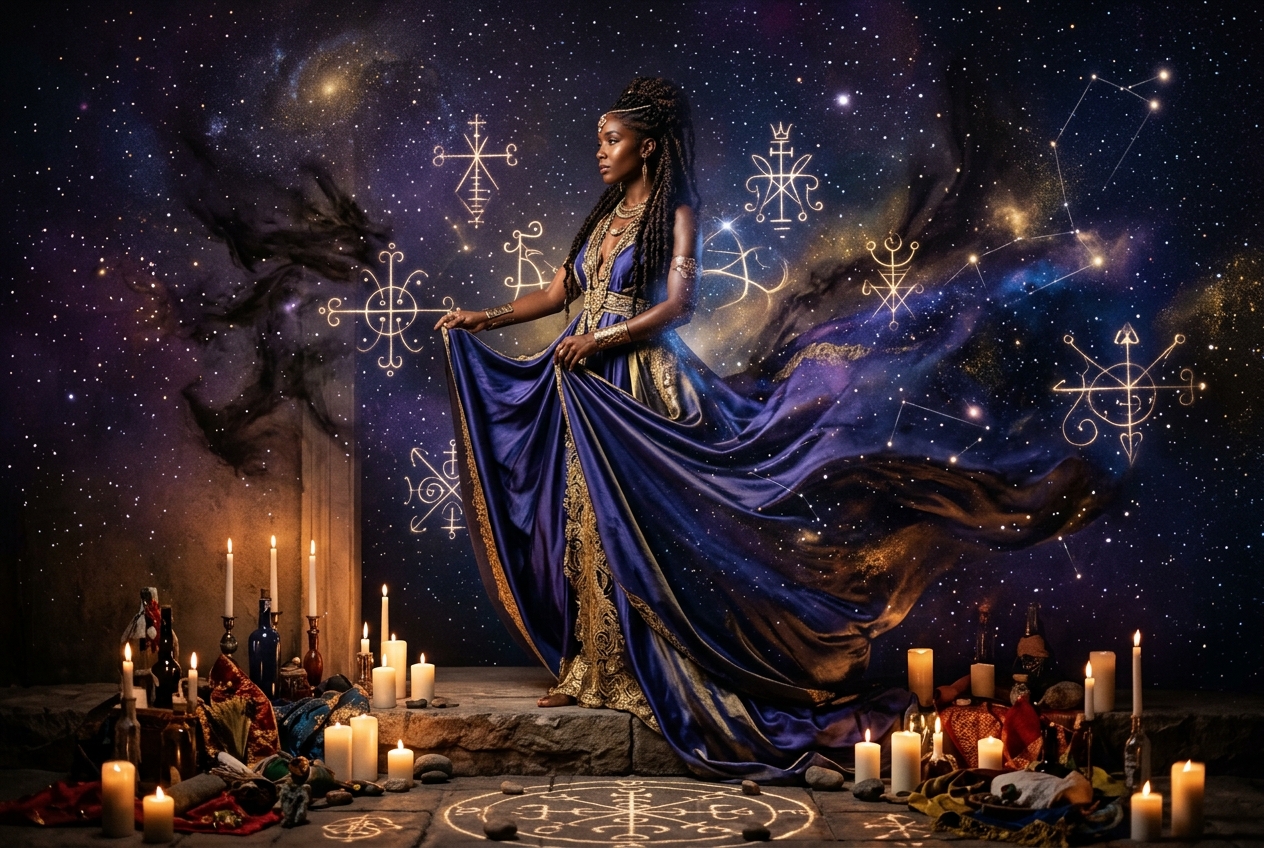
In 2022, an entire cinema wept and cheered as a laundromat owner learned to jump between parallel versions of her own life. Everything Everywhere All at Once made the multiverse feel intimate, domestic, almost spiritual. What almost no one in those theaters knew was that a Haitian-American physician had, two decades earlier, written a book insisting that his grandmother's religion had been doing exactly this all along — and calling it by its right name.
That book is The Vodou Quantum Leap: Alternative Realities, Power, and Mysticism, published in 2000 by Dr. Reginald Crosley (1937–2020), a practicing internist and nephrologist who spent his professional life inside Western medicine and his interior life inside the cosmology of his ancestors. Crosley's audacious thesis is that operational Vodou — the working kind, practiced in secret societies, not the tourist kind — is not superstition dressed as faith but a form of applied physics. The crossroads is a coordinate. The lwa are travelers. The ceremony is an interface.
His central figure is the voltigeur, the 'magical leaper' who can cross between the manifold dimensions the priests always insisted were there. Read that against a culture currently obsessed with Marvel's multiverse and Spider-Man's spider-verse, and something uncanny happens: the pop-cultural fantasy of dimension-hopping starts to look like a diluted, computer-generated echo of a much older claim. Crosley's move is to take the ancient claim seriously — to line it up beside dark matter, parallel universes, and the stranger corners of quantum theory, and ask whether the mambos were describing the same territory the physicists are only now naming.
The book is at its most hypnotic when it turns to the architecture of the soul. Crosley distinguishes the semido — the aspect that keeps its earthly hungers for food, sex, and music — from the selido, which does not return to the living. He describes the zin, a vessel holding hair or nail, a biological anchor kept alive through periodic rituals of fire. To a generation raised on cloud backups, DNA ancestry kits, and the dream of digital immortality, the zin reads less like folklore and more like a prophecy: the intuition that a person can be stored, tethered, and revived through a fragment of the body. Silicon Valley calls it 'the singularity.' Haiti called it the zin, and it was tending the servers by candlelight centuries first.
Crosley does not flinch from the fearsome material either — the red sects, the Bizango and Makaya, the mechanics of possession and channeling. This is where a lazier writer would reach for spectacle, and where he instead reaches for structure, treating possession as a kind of bandwidth, a body opened as a receiver. It is impossible to read these chapters in the age of Afrofuturism — of Sun Ra's cosmic exile, of Janelle Monáe's android messiahs, of Wakanda's ancestral plane — without recognizing the same insistence running underneath all of it: that Black spiritual traditions were never behind science. They were ahead of it, speaking in a grammar the West hadn't built the instruments to hear yet.
For all its ambition, the book asks to be read with both hands — one holding the wonder, one holding the discernment. Crosley is a synthesist, and synthesists overreach; the quantum metaphors sometimes gallop past what the equations can bear, and a careful reader will feel the seams between the poetry and the peer review. But that tension is the point. The Vodou Quantum Leap is not trying to win a physics argument. It is trying to restore dignity to a cosmology that colonizers spent centuries mocking — to say that a people who were told their gods were devils had, in fact, been keeping a map of the universe.
That is why it belongs on our shelf. This is a matriarchal book in the deepest sense: it treats inherited, embodied, ancestral knowledge as data, and it refuses the modern insult that mystery and intelligence are opposites. Read it beside the multiverse you already love from the movies, and let it do the older, harder work — wrapping tonight's cultural fascination back into the ancient mystery it forgot it came from. The ancestors, Crosley insists, were reading physics all along. We are only now catching up to the syllabus.
Further reading
Culture carried across distance and time.
Discover The Horizon Circle