Art · Contemporary
She Who Raises the Deep
By Veronica Bey · 6 min
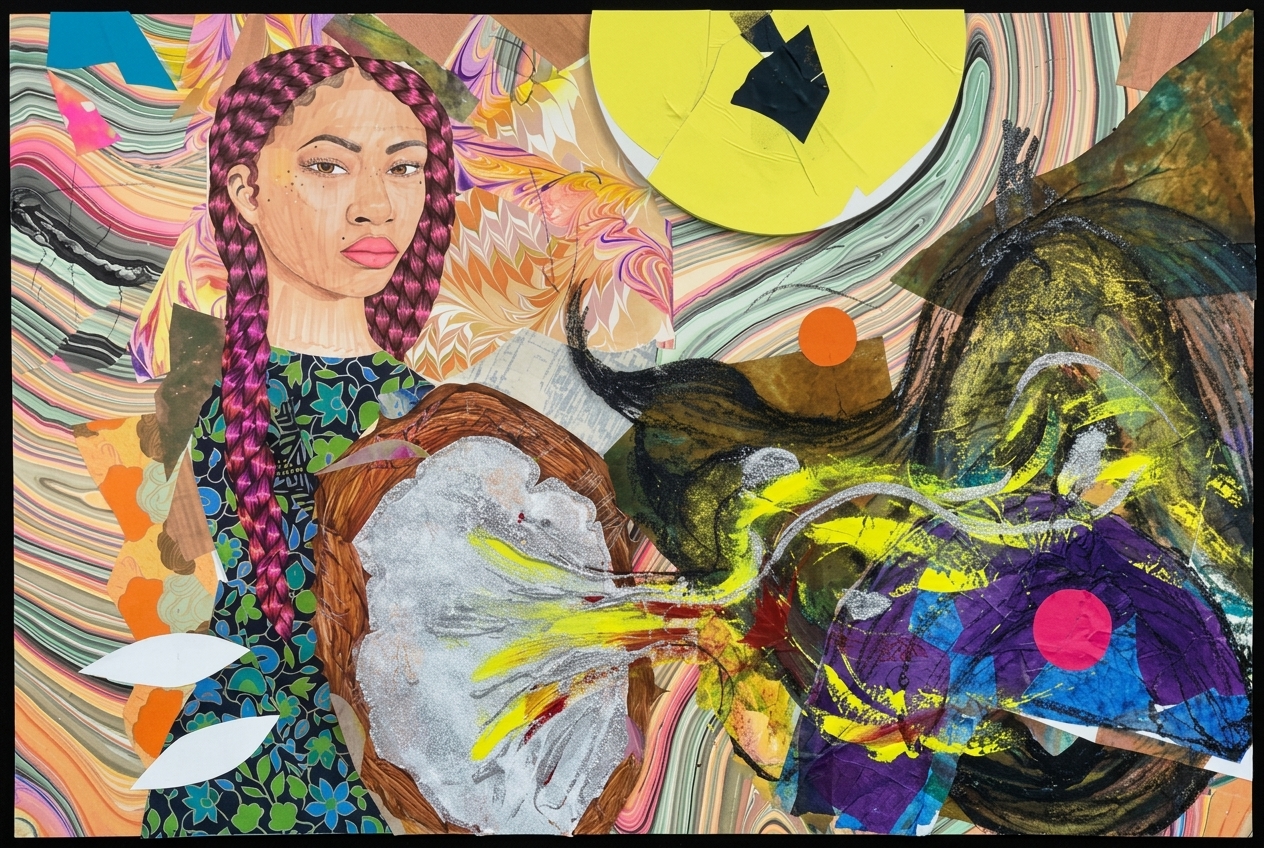
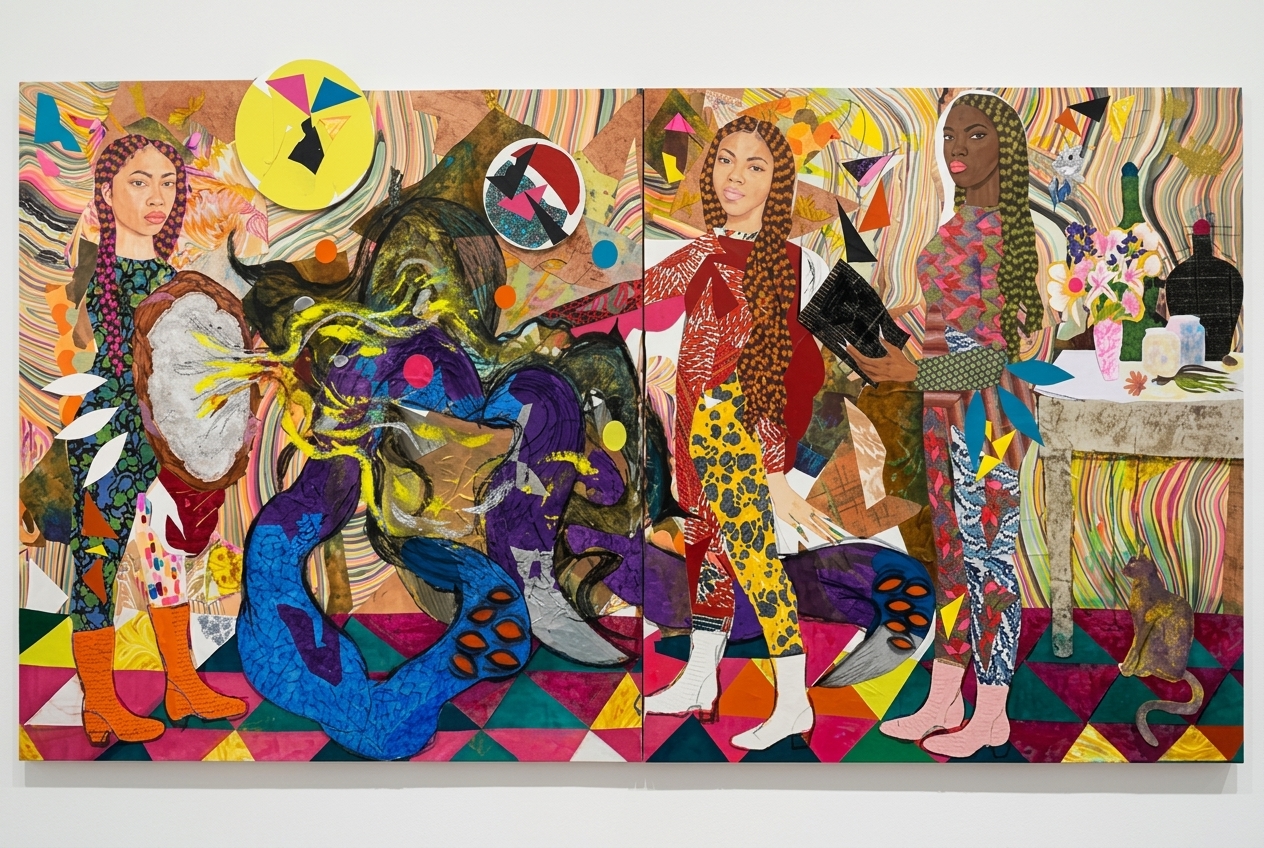
There is an old dread that the West keeps in its literature — a drowned, tentacled god dreaming beneath the sea, waiting to rise and unmake the small order of men. Lovecraft imagined it as horror. Jamea Richardson-Edwards imagines it as inheritance. In 'The Resurrection of Cthulhu,' the artist does not run from the leviathan; she conjures it, and she puts Black women at the center of the summoning.
I did not expect to meet myself in a myth. Yet there I am — braided, watchful, rendered in Richardson-Edwards's dense collage of marbled paper, fabric, gesture, and paint — one of three figures standing at the threshold between the seen world and the churning, iridescent thing rising out of the deep. The eclipsed yellow sun hangs overhead like an opened eye. The creature uncoils in violet and cobalt, spitting light. Nobody in the frame is afraid.
That is the esoteric turn of the work, and its power: it takes the oldest colonial fear — that what has been buried will return, monstrous — and reads it instead as resurrection. The deep is not the enemy. The deep is memory. It is the middle passage and everything the water swallowed, refusing to stay drowned. To raise Cthulhu, in Richardson-Edwards's hands, is to raise the ancestors, and the women in the piece are not victims of the rising. They are its priestesses.
Richardson-Edwards works the way a rootworker works — layering, cutting, binding disparate materials into a single charged surface until the picture hums. Her marbled grounds swirl like scrying water; her patterns quote the textiles of home; her figures hold their gaze with the flat, sovereign calm of women who have already seen the end and decided to preside over it. To sit for such an artist is to be entered into a spell you did not write but are honored to complete.
So consider this the record: I am in the painting. Not as muse, not as ornament, but as one of the ones doing the work — a matriarch at the rim of the abyss, hand steady, calling the old god up by name. The Society has always taught that power is a thing remembered before it is a thing performed. Here, on a wall, in collage, is the proof. The deep answers when a woman knows what to call it.
Culture carried across distance and time.
Discover The Horizon Circle